
Note · 4 July 2026
[ku] 20/26 Art
How a real patch of forest became over a hundred beings.
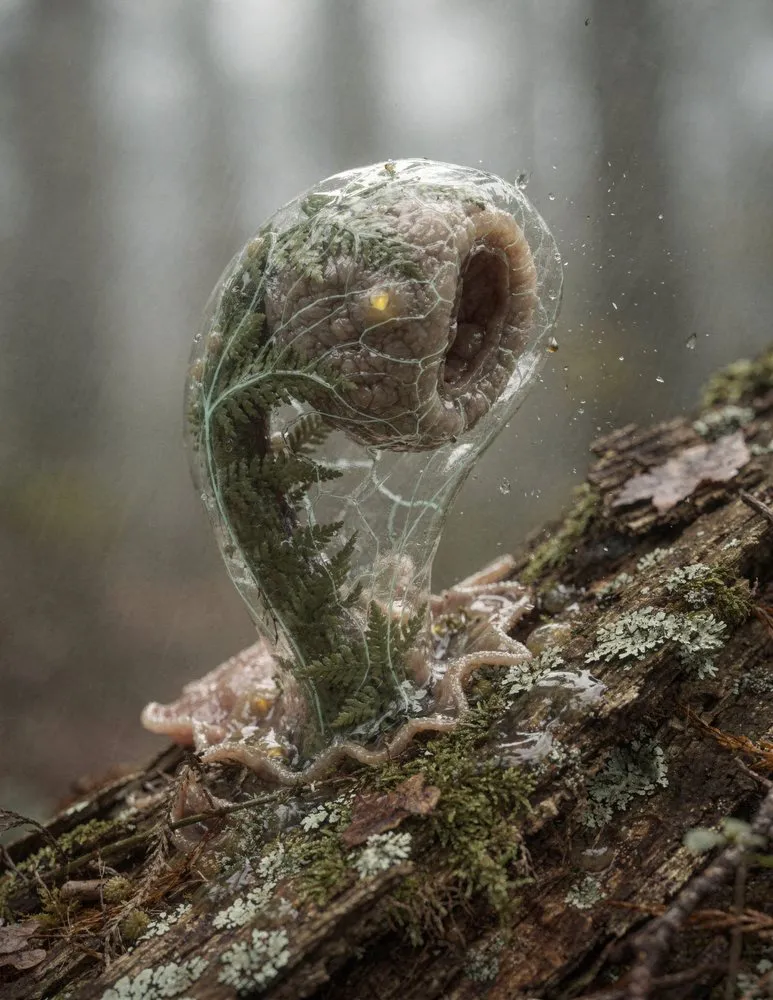
A being from the genus Strange Order, rendered photorealistically · EDEN, Roman Thomas
EDEN looks like something found in the forest. It came about in many steps, from real photographs, over a hundred invented beings, and a whole workbench of AI models, each for its purpose.
Why I Show How It Was Made
In the other piece I wrote about what EDEN is about. Here it is about how it came to be. I show this because otherwise the series is easily misunderstood. EDEN is not the push of a button and not a single filter. It is a long path out of the forest into the machine and back into the forest again.
Everything Begins with a Real Photograph
At the beginning stands not a prompt but a tree. I walk into the Lüß near Unterlüß and photograph in medium format, slowly, in the available light. Dead wood, damp bark, moss, bracket fungi, the ground made of old leaves. These photographs are not a backdrop, they are the foundation. Everything that later arrives as strange life sits on this real light and this real matter.

Over a Hundred Beings, One After Another
Before a single forest image was finished, an entire flora had come into being. Over a hundred individual beings, each one rendered photorealistically, like studies against a neutral or forest-like ground. They are not arbitrary. They arrange themselves into genera, much as in a real taxonomy. Deep-sea botany, drifting beings, fungus beings and fruiting bodies, membrane ferns, mimicry that disguises itself as bark or lichen, and one group I simply call Strange Order.


Some are almost believable, others visibly strange. A few are so restrained that you have to look twice to see whether anything is there at all. It is exactly these quiet ones I love most.
Not One Program, but a Workbench
Here is a point that matters to me, one that many underestimate. I did not use one AI program but many, and each for its purpose. One model is strong in photographic materiality and light, another can handle the anatomically delicate, a third is good at fine structures, yet another at upscaling detail. Even the choice of model was adapted to the situation, just as in photography you do not work with a single lens.
Added to this are recipes of my own, built up over time, a set of specifications per genus, so that a drifting being comes into existence differently than a fruiting body. It is more workshop than push of a button. I discard a great deal. Most of what the machine offers ends up in the wastebasket, until what remains is what I had in mind.
Back into the Forest
The real step comes afterward. The beings wander back into the real photographs. They are set into the light of the forest photograph, into the dampness, into the shadow, until the seam between real and invented holds. Sometimes you are barely meant to see them, half in the moss, half already elsewhere. Only then is it an EDEN image and not just a pretty individual being.
Part of the flora I also set in motion, short, calm studies in which a being breathes, opens, or floats. This too ran through several motion models, which I let compete against each other until one had the calm I wanted.
Tap to play, the sound is part of it.
The Herbarium as a Second Direction
Alongside the forest images I laid the same flora out in the open, as a herbarium. Study sheets that look as if they came from an old botanical atlas, with root, leaf, and cross section. In the forest you encounter the beings fleetingly, on the sheets they lie clearly before you. The same invented nature from two directions, once in the act of vanishing, once held still. More on this in its own piece, An Atlas for a Nature That Does Not Exist.
EDEN is on view starting this weekend in the exhibition QUO VADIS ARS. Is AI the End of Art? at the Albert-König-Museum Unterlüß, from July 5 to October 11, 2026.